
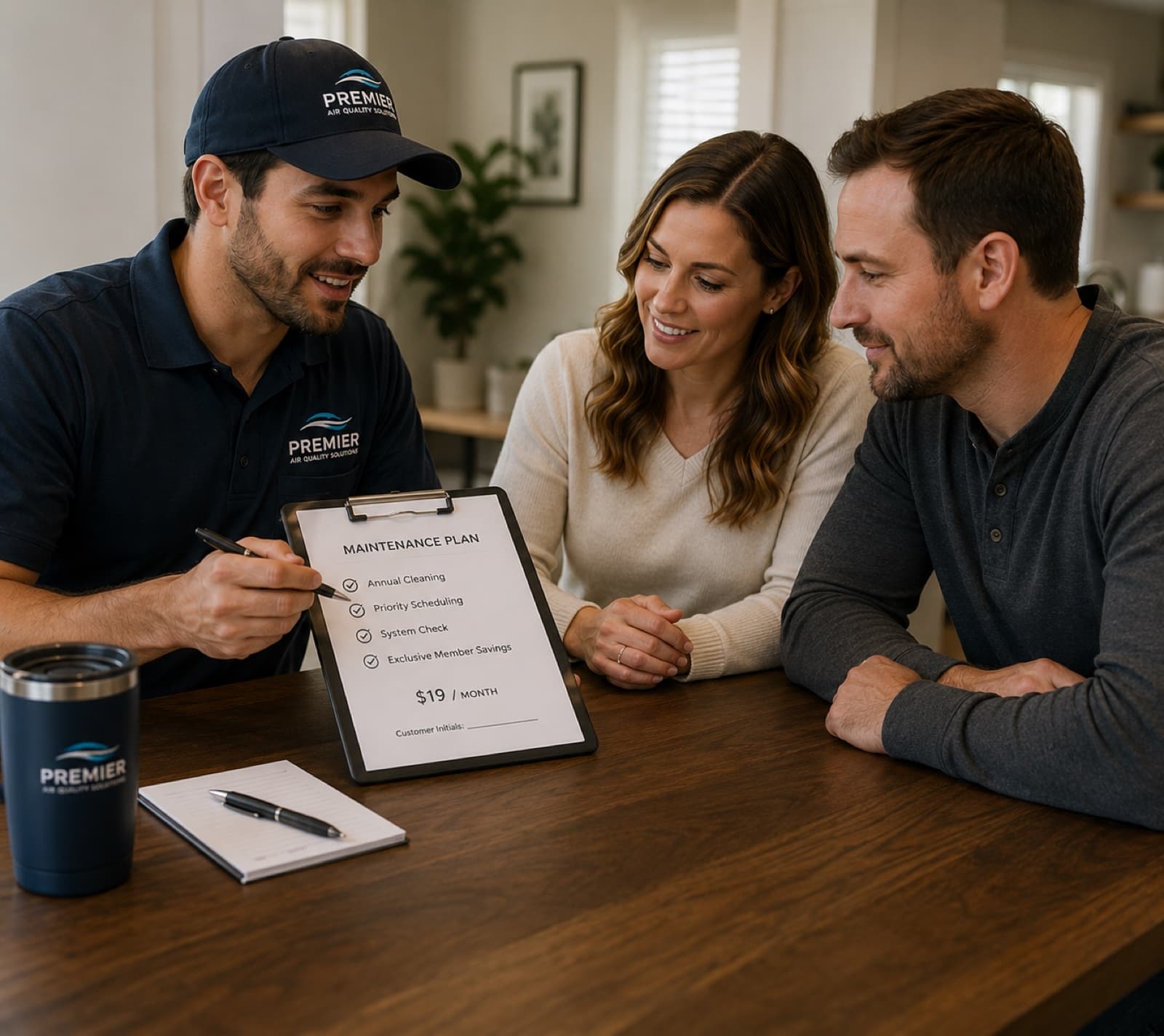
A healthy maintenance agreement penetration rate is 30 percent or higher of your active customer base enrolled on a recurring service plan. Top HVAC and plumbing operators push well past that; below roughly 20 percent, the business is leaving its most valuable, most predictable revenue on the table.
MA Penetration = Active Members ÷ Active Customers
Why Does Membership Matter More Than the Plan Fee?
The plan fee itself is almost beside the point. Membership matters because of what it changes downstream: members book more, cancel less, and — critically — call you first when something breaks or needs replacing. The rule of thumb is that a member is worth several times a one-time customer over their lifetime, which is exactly why penetration shows up as an input to CAC and LTV:CAC. A high-penetration book of business is, functionally, a lower acquisition-cost book of business — you are not paying a marketing channel to re-win a customer you already earned.
Penetration also smooths demand. A shop that lives on one-call-away emergency work is exposed to whatever the weather does that quarter. A shop with a real member base has a baseline of tune-up and inspection visits scheduled months out, which is easier to staff against and easier to forecast off of — the same forecasting discipline that shows up in revenue per technician once the schedule stops being all-or-nothing.
| Penetration | What it signals |
|---|---|
| Under 20% | Under-selling plans; revenue is feast-or-famine |
| 20–30% | Building, but membership is not yet a habit |
| 30%+ | Recurring revenue is a real base under the business |
How Do You Calculate Penetration?
The formula is deliberately simple: active members divided by active customers. "Active" is the word that trips people up, on both sides of the fraction. Active customers should mean people you have served in a defined trailing window (commonly 12–24 months) — not every name that has ever been in the CRM. Active members should mean plans that are currently paid and in force, not plans sold at any point historically, including ones that quietly lapsed.
Here is a purely illustrative, hypothetical example to show the arithmetic — not an industry data point. Say a shop has 900 customers active in the trailing 18 months, and 210 of them are current on a maintenance plan. That is 210 ÷ 900 = 23 percent — solidly in the "building" band, not yet the "real base" band. If that same shop signed 60 more members without losing any current ones, it would cross 30 percent (270 ÷ 900). The math shows why the two variables that move this number are always the same two: how many people you ask, and how many people you keep asking retained.
Get the denominator wrong and the whole metric lies to you. A shop that never prunes dead customers from its "active" count will understate its real penetration among people it actually still serves; a shop that counts every membership ever sold, lapsed or not, will overstate it. Pull both numbers from the same system of record and the same date range every time you check it.
What Drives Penetration Up or Down?
Two structural things move this number more than anything else: whether a plan is offered on every qualifying visit, and whether renewal is automatic.
Offer rate is the one most shops underestimate. If plans are only pitched when a customer asks, or only by the technicians who happen to be comfortable selling, penetration caps out low no matter how good the plan is — most customers simply never hear the offer. The fix is not a better script; it is making the offer a mandatory step on every qualifying ticket, tracked the same way a callback or a close is tracked.
Renewal mechanics matter just as much on the other side of the equation. A plan that has to be manually re-sold every year bleeds members to inertia and forgetfulness, not dissatisfaction — the member meant to renew, then didn't get around to it. Auto-renew (with a card on file and a simple opt-out) turns a once-a-year sales event into a background process, which is the difference between a penetration number that has to be rebuilt annually and one that compounds.
How Do You Raise Penetration?
The two levers above are the whole playbook: offer a plan on every qualifying visit rather than only when asked, and make renewals automatic instead of a yearly re-sell. Layered on top of those two levers, a few habits separate shops that hit 30 percent from shops stuck in the high teens:
- Make the value concrete, not abstract. "Priority scheduling and a discount on repairs" lands better than "peace of mind." Tie the pitch to something the customer just experienced on today's visit.
- Track the metric to watch alongside it: member retention. Signing plans means little if they lapse just as fast — penetration is a stock number, and retention is what keeps the stock from draining out the bottom.
- Coach the offer like any other close. The same discipline that improves your estimate close rate applies here — a consistent ask, tracked per technician, beats an occasional great pitch from your best closer.
- Review it in the weekly numbers meeting. A metric nobody looks at weekly does not move; folding penetration into a weekly operating meeting keeps offer rate and renewal rate visible alongside the rest of the scorecard.
How Does Penetration Vary By Trade And Size?
Penetration targets are general industry benchmarks and they vary by trade. Recurring maintenance is a bigger lever in HVAC — where seasonal tune-ups are an obvious, expected touchpoint — than in project-heavy electrical, where much of the work is one-off installs and code corrections that do not lend themselves to a recurring visit cadence. Plumbing sits in between: drain and water-heater maintenance plans exist and work, but the natural visit frequency is lower than HVAC's twice-a-year tune-up rhythm.
Size changes the mechanics more than the target. A single-truck shop can hit strong penetration through sheer owner attention — the owner remembers to ask, and knows most of the customer base by name. A multi-crew shop cannot rely on that; it needs the offer built into the dispatch and invoicing workflow so it happens the same way whether the technician on-site has been there ten years or ten weeks. The number that matters is the same at every size — the discipline required to hit it scales with headcount.
What Metrics Does Penetration Connect To?
Penetration does not operate in isolation — it is one input among several that determine whether the business's margin structure holds up. It feeds CAC and LTV:CAC directly, since members lower the effective cost of keeping a customer. It also interacts with gross margin, because plan revenue tends to carry different material and labor ratios than one-off repair work, and with net profit margin, since a more predictable revenue base makes it easier to staff efficiently instead of carrying idle payroll between emergency calls.
It also touches technician-level performance. A member base with scheduled maintenance visits gives dispatch more control over the calendar, which supports steadier technician billable utilization than a schedule built entirely around unpredictable break-fix calls. None of these connections require a new number — they are the reason this one number is worth checking every month rather than once a year.
Common Mistakes That Cap Penetration
The most common cap on penetration is simply not offering the plan — treating it as an upsell for the customer to request rather than a standard part of every qualifying visit. Close behind that is a stale denominator: counting customers who have not called in years as "active," which quietly deflates the ratio and hides real progress (or masks a real problem).
The other frequent trap is counting a sale as a win and moving on. A membership sold once and never followed up on lapses at renewal, especially without auto-pay, and a shop that only tracks new enrollments — never retention — will see its penetration number stall or slide even while "membership sales" look fine on a monthly sales report. Recurring-revenue billing and cash-flow mechanics aren't unique to this industry; the SBA publishes free, general guidance on pricing and cash flow that applies well beyond home services, if the renewal and billing side of the program needs tightening up.
Trade-specific guidance is worth a look too. ACCA, the HVAC contractor trade association, publishes standards and best-practice material relevant to structuring maintenance and tune-up programs, and ENERGY STAR maintains general guidance on the efficiency benefits of regular HVAC maintenance — useful, factual framing to build into the customer-facing pitch for why a plan is worth having, separate from any specific discount you offer.
Frequently Asked Questions
What is a good maintenance agreement penetration rate for HVAC?
Aim for 30 percent or more of active customers on a plan. Strong HVAC operators exceed that; under 20 percent usually means plans are not being offered on every visit. The 20–30 percent band is a normal building phase, not a red flag on its own — check whether the trend is moving up.
Why do maintenance agreements matter so much?
Members produce predictable recurring revenue, buy more over their lifetime, and call you first for repairs and replacements — lowering acquisition cost and smoothing seasonal demand. That predictability is also what makes staffing and scheduling decisions easier to make with confidence rather than guesswork.
How do I increase membership penetration?
Offer a plan on every qualifying visit, make the value concrete, and automate renewals so members are not re-sold each year. Track both new enrollments and retention — a rising sign-up count paired with a shrinking active-member count means the leak is on the renewal side, not the pitch.
Does penetration matter as much outside HVAC?
Less, but it still matters. Plumbing supports real maintenance-plan revenue around water heaters and drains, just at a lower natural visit cadence than HVAC's tune-up cycle. Project-heavy electrical work rarely lends itself to a recurring plan at all, so penetration is a smaller lever there than the trade's other core metrics.
What is the biggest mistake shops make with this metric?
Treating a sold membership as done. The plan has to be tracked at renewal, not just at signup, and the offer has to be built into every qualifying visit rather than left to whichever technician happens to remember. Both failures show up as a number that looks fine on paper and drains in practice.
Want to see your membership penetration and what it is worth? Book a call and we'll walk through your numbers together.